AI is a tool for execution, not decision. How to build your own agents.
The long-form companion to the essay below: architecture, a procurement example, the ROI, costed. 9 min.
'AI costs more than an employee': the problem isn't the price. It's the lack of a plan.
Written in May, before Meta confirmed it. 6 min.
Build, Partner, Buy or Defer: McKinsey's agentic AI framework, read from the procurement seat.
Defer is a legitimate move. Useful during the trough. 7 min.
Let’s demystify agent-building.
Most buyers think an AI agent is something you code, and therefore something complicated. So the topic waits for IT to help, for a budget to be unlocked, or it ends with one more SaaS subscription. Let’s demystify: a useful procurement agent is easy to build once your ideas are clear and you can settle the business questions. The tech comes after, and the subscription you probably already have is enough to code agents and run them.
First, what an agent is. Not a chatbot. An agent is a language model you give tools (your Excel, a folder of PDFs, an inbox), a loop (it acts, observes, goes again) and a perimeter (what it is allowed to touch). The chatbot answers. The agent does.
The real secret of agent-building: knowing how to lay out your workflow cleanly. Telling the AI what to look for, where, in what order, and how to present the result. Without that framing, the model guesses, and the deliverable changes on every pass. An agent is nothing more than that framing written down once. If you can explain your task to a new colleague, you can write an agent. The AI will guide you through the technical parts.
Frame it the way you would frame a new hire (the full parallel is in HR processes for AI agents): five decisions, in order.
The workflow, not the tool. Which recurring task is the best candidate for automation through an agent? What are its steps, precisely, and how should the result be delivered? Example deliverables are a good starting point.
What the agent touches, and nothing else. A narrow perimeter that works will always be more effective than a wide, uncontrolled one.
Its access, read and write. Reading your PDFs: yes. Emailing a supplier with no review: no. Permissions are granted one by one, and never “just in case”.
The human stop point: before any external send, before any spend commitment (above a threshold, which should be €0 to start). It’s what makes the agent deployable.
Time saved, error rate on a sample, human corrections. Without a measure, you’ll never know whether to keep it and what to improve. Plan to identify the baseline from day one.
One last point, the cost. The price per token varies by a factor of 10 or more between the low end and the high end of models ($0.10 to over $50 per million tokens) (public vendor price lists, 2026). The model behind your agent is a purchasing decision, and the most important one once the right process is defined: the playbook is on the blog, manage your AI costs.
How do you choose? Run trials with different models for each step and compare the results. You don’t need Fable or GPT Sol to read an email or a PDF; keep the frontier models for the real reasoning tasks.
An agent doesn’t replace judgment. It gives you back the time to exercise it.
And when it isn’t the right call. Non-recurring workflow, unmeasurable result, or a mistake that costs too much without a human in the loop: don’t use AI. An agent that approves purchase orders faster with nobody watching is a risk running on a loop, not augmentation. In all cases, the agent is a tool for execution, not decision.
Before asking for a budget or a developer, write your five decisions on one page. If you can’t fill them in, the agent isn’t the problem: the workflow needs rework.
The long version, with the four-layer architecture and the costed ROI: how to build your own agents (9 min).
The race restarts with four. In the middle of the trough of disillusionment.
Let’s run through the month’s timeline, because it’s packed. On June 9, Anthropic released Fable, its most powerful generally available model. On the 12th, Washington ordered it cut off under an export-control directive, following a report by Amazon researchers showing a bypass of the cyber safeguards (Fortune, CNBC, 2026). On June 30, controls lifted; on July 1, access to Fable was restored with reinforced safety (Anthropic; Al Jazeera, 2026). And for the first time, the frontier model is billed on usage, outside the classic flat plan. During the blackout, three big shifts on the AI scene:
June 13 · GLM-5.2 (Zhipu, China). Open-weight under MIT license, 1 million tokens of context, best open-weight coding model just behind Opus 4.8 (CNBC; SCMP, 2026). Free, self-hostable: a realistic plan B just became available, with no dependence on the US.
Late June · Fugu (Sakana, Japan). The twist: not really a new model, an API that orchestrates several expert models (Sakana; VentureBeat, 2026). The orchestration layer lets several less capable models reach frontier-level performance together. The problem? The models underneath are still American.
June 26 · GPT-5.6 (OpenAI, US). Sol, Terra, Luna, public release on July 9 after the same trip through the government checkpoint (OpenAI; CNBC, 2026). Terra: GPT-5.5 performance at 2× lower cost. Prices are already falling, one step below Anthropic’s frontier.
What it changes if you buy AI. The cutoff demonstrated that access risk is real. The market proved that models and players move in weeks, not years. Conclusion: don’t lock yourself in. The balance of power can flip: Anthropic, which seemed to be running away with it last month, is now in a perilous position on the frontier, while mid-range models (e.g. Sonnet) keep improving too. Concretely: add reversibility to the contract, the CADA grid for data residency (European Commission, 2026), and a multi-AI benchmark at every negotiation. Model choice remains a measurable purchasing decision: across 186 simulated agent-to-agent negotiations, the frontier captures 10 to 25% more value than the entry level (Anthropic, Project Deal, 2025). I detailed the experiment here.
And the paradox of the month: this unprecedented market situation lands right in the trough of disillusionment, the moment we all realize AI isn’t a magic wand. Gartner places generative AI there for all of 2026 (Gartner; TechRepublic, 2026). Look at the curve:
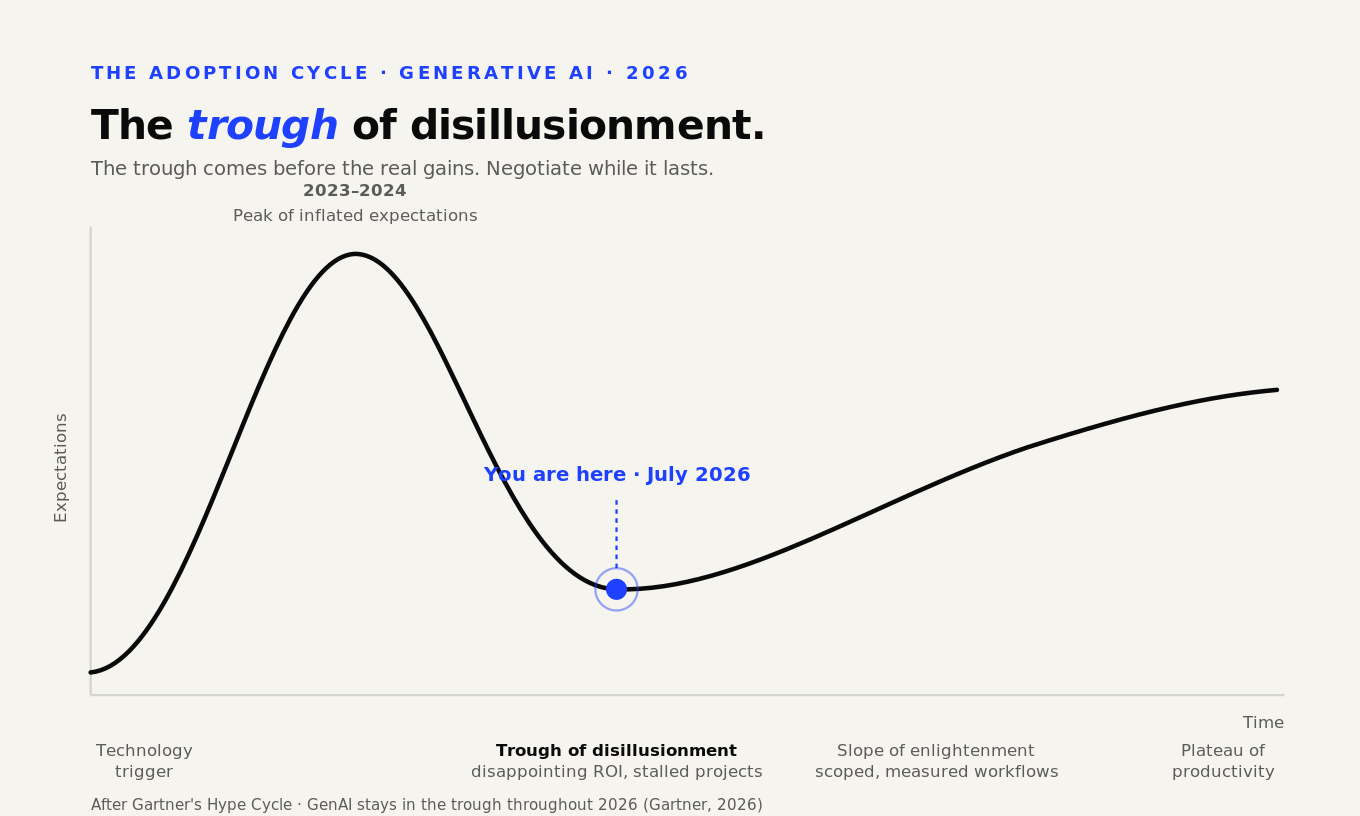
The trough’s headlines: Meta admits its agents are moving slower than planned, after ~$145 billion invested and 8,000 jobs cut (TechTimes, 2026); more than 40% of agentic AI projects expected to be scrapped by 2027 according to analysts (TechTimes, 2026); 80% of employees avoiding the AI tools deployed to them (Fortune, 2026). Read it as a buyer: ROI unclear? Demand value milestones and an exit clause at renewal (I laid out this case back in May: the problem isn’t the price). Adoption stuck? Pay on observed usage, not provisioned seats. And after the trough comes the slope of the real gains, for those who industrialized while everyone else froze: AI spending keeps climbing right through the trough, $2.52 trillion forecast for 2026, up 44% (Gartner, 2026). And make no mistake: job postings for AI adoption managers are exploding, a clear sign that part of the market keeps building its capabilities at full speed.
The trough is when vendors get polite again. Make the most of it.
This month in augmentation.
Ramp launches its AI agents for procurement.
Agents that spot compliance risks across the procurement process (PYMNTS, 2026). Compliance moves from a manual end-of-chain control to continuous monitoring, inside the tool your teams already use.
Autonomous agents raise money.
Procure AI: $13M for autonomous sourcing agents; ProcurePro: $11M for construction procurement (TechFundingNews, Procurement Magazine, 2026). Investors are no longer betting on AI that assists, but on AI that acts.
The number to keep in mind.
80% of procurement leaders name AI the most structuring trend of the next five years (The Hackett Group, 2026). Everyone agrees on the importance, almost nobody has a costed use case. The gap between the two is your possible head start.
Your first agent: supplier sourcing.
This month, we build an agent on a case that saves days of work, and we start at the beginning: sourcing a new need. Only yesterday, building a good supplier list took years of industry knowledge, or an expensive engagement with a sourcing firm. AI brings that barrier down: longlist, RFI, analysis, compared shortlist. Three steps you steer, the agent executes, and you validate each one before moving to the next.
I have a new need: [describe the product or service, the volume, the delivery zone, the constraints, the technical documents if they exist]. My selection criteria, in order of importance: [price, lead time, certifications, capacity, proximity]. Step 1: propose a longlist of candidate suppliers with, for each one, why it could fit and what remains to be verified. Do not fill in any unverified data: mark it “to be confirmed”. I validate the longlist before we move to the RFI.
The longlist works best on live sources rather than the model’s memory alone. Three methods that work in France: searching by NAF/APE code via INSEE’s Sirene API (free), the legal and financial data from Pappers to check a candidate’s health, and the French government’s company directory. For industrial Europe, Europages and Kompass complete the coverage. And a field note: for manufacturing suppliers, Grok (X’s AI) is surprisingly effective at finding candidates. Compare the list against the company’s existing suppliers to spot the genuinely new ones.
The RFI is easy to generate in Excel, aligned with your criteria. But you can ask the agent for better: a simple web page that hosts the questionnaire and writes each answer straight into a database. A far better experience for the supplier, zero re-entry for you, clean data from the moment it’s collected. We can finally break free from Excel!
Once the answers are back, the agent validates the information by cross-checking it against the public sources above, flags the gaps and inconsistencies, and presents it all visually: comparison grid, strengths and weaknesses, a ranked and justified shortlist. The agent prepares the decision, it doesn’t make it.
On a real sourcing case: the time from expressed need to ready shortlist (before / after), the number of suppliers compared, and how many times the grid had to be redone.
The agent clears the ground: it lists, questions, compares. You decide.
The full guide (longlist, RFI, synthesis, ROI assumptions) is available on the site. A question about your case? Write to me, I answer every message.
What if we used something other than Excel to track procurement performance?
One thing I’ve seen in most organizations, and it has always surprised me: how hard it is to track savings. Either the tracking lives in a complex S2P suite, accessible only to large groups, and rarely used. Or it’s an Excel process, unauditable, and therefore inspiring little confidence. I wanted to change that: a savings-tracking platform built for procurement teams. Every gain logged with its baseline and its calculation method. Enough to bring the CFO a number that holds, not a number you hope for.
Have you already built an agent for a procurement workflow? Which one, and what did it really win you?
I collect the answers and publish the best ones, anonymized, in N°3.
Reply to Alex →P.S. You’ll forgive the late arrival of this issue, I’m just back from my wedding in Kazakhstan!