
Understanding the New European “ESPR” Regulation on Ecodesign
The European Union (EU) has taken significant steps to promote sustainability and reduce environmental impact through regulatory frameworks. One of the latest initiatives is the Ecodesign for Sustainable Products Regulation (ESPR). This regulation aims to improve the sustainability, durability, and circularity of products sold within the EU, ensuring that they are designed with their entire lifecycle in mind. The regulation introduces a few majors changes : the possibility to set new ecodesign requirements as standards for products to be sold in EU, the creation of a Digital Product Passport, and introduce a ban on the destruction of unsold consumer products. It also steer the €1,8 trillions Public spending towards more sustainability.
This article provides a comprehensive overview of the ESPR, its objectives, key requirements, and implementation timeline.
Find the PDF summary here.
Access the EU page related to CSRD here.
What is the new ESPR?
The ESPR is the newest piece of EU regulation to promote products that are more durable and circular. This regulation is aligned with the Circular Economy Action Plan (CEAP) and the European Green deal. It entered into effect on july 18th 2024 and creates a framework for European lawmakers to set new standards for ecodesign, circularity and environmental performance of manufactured goods in the European market.
The regulation sets a highly positive precedent, by aiming to make all products sustainable by default and giving the European Commission the right to implement stricter sustainability requirements across various product categories. The most polluting products are given priority, i.e. intermediate products such as iron, steel and aluminium, lubricants, and chemicals; and products, such as textiles, detergents, electronics, among others.
The EU defines sustainable products as displaying at least one of these characteristics :
- Uses less energy
- Lasts longer
- Can be easily repaired
- Parts can be easily disassembled and put to further use
- Contains fewer substances of concern
- Can be easily recycled
- Contains more recycled content
- Has a lower carbon and environmental footprint over its lifecycle
The key new feature: Ecodesign requirements
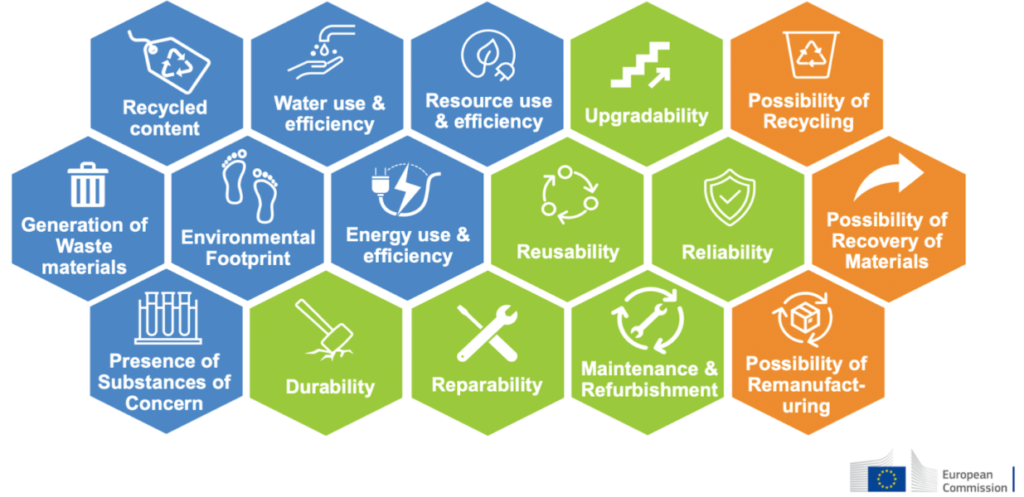
The ESPR main feature is that is enables setting new ecodesign standards for virtually any goods sold in Europe (with some exceptions such as Food and Feed). These standards are known as “ecodesign requirements” so that businesses:
- Improve product durability, reusability, upgradability and reparability
- Make products more energy and resource-efficient
- Address the presence of substances that inhibit circularity
- Increase recycled content
- Make products easier to remanufacture and recycle
- Set rules on carbon and environmental footprints
- Improve the availability of information on product sustainability
For each category of products, baseline standards will be set and products will have to comply to be allowed to enter the European market. Here is a simplistic version of what these ecodesign requirements may look like:
As of July 2024, these standards are not yet set and a first version is expected through mid-2025 after the ecodesign Foru. The first draft of these ecodesign requirements is expected to focus on the following industries :
- Iron & steel,
- aluminium,
- textiles (garments and footwear),
- furniture (including mattresses),
- tyres,
- detergents, paints, lubricants, chemicals,
- energy-related products (including new measures and revisions of existing ones),
- ICT products, as well as other electronics.
The digital product passport
The ESPR also introduces a Digital Product Passport (DPP), a digital identity card for products, components, and materials. This new digital ID will store relevant information to support products’ sustainability, promote their circularity and strengthen legal compliance:
- Product’s technical performance
- Materials and their origins
- Repair activities
- Recycling capabilities
- Lifecycle environmental impacts
The information will be made available electronically by the manufacturers.
Ban on the destruction of unsold consumer goods
The ESPR sets the ambitious goal to eliminate consumer waste, starting with unsold products. The approach relies on two distinct axis, like a good cop/bad cop.
- Raising awareness : There is little visibility on what’s actually destroyed so as a first step, the EU will require large and eventually medium-sized companies across all product sectors to disclose annual information on their website, such as the number and weight of products they discard, as well as their reasons for doing so. This should bring awareness on the topic and let consumers make better choice.
- the number and weight of unsold consumer products discarded per year, differentiated per type or category of products;
- the reasons for discarding products, and where applicable, the relevant derogation under Article 25(5);
- the proportion of discarded products delivered, whether directly or through a third party, to undergo each of the following activities: preparing for reuse, including refurbishment and remanufacturing, recycling, other recovery including energy recovery, and disposal operations in accordance with the waste hierarchy as defined by Article 4 of Directive 2008/98/EC;
- measures taken and measures planned for the purpose of preventing the destruction of unsold consumer products.
- Ban on the destruction of unsold Consumer Goods in EU. Starting with the textile industry as they are a key contributors to waste, the EU is purely prohibiting the destruction of unsold goods. The Commission estimates that “4 to 9% of all EU textile products is destroyed before use, amounting to between 264,000 and 594,000 tonnes of textiles destroyed each year”.
The concept of destruction as outlined in this Regulation should cover the last three activities on the waste hierarchy, namely recycling, other recovery and disposal; this makes the goal even harder to reach. Preparation for reuse, including refurbishment and remanufacturing, should not be considered destruction.
The ban on the destruction of unsold textile should enter effect in :
- 2 years for large companies
- Medium sized companies will benefit from a 6 year exemption
- While Small and Micro companies remain exempt.
- And more industries should follow suit, including IT!
Green public procurement
Finally, the ESPR will also help steer some of the €1.8 trillion EU public spending to more circular and sustainable products and services.
The ESPR makes the evaluation of sustainability criteria mandatory in tenders so that EU public spending aligns more toward its Green Deal objectives. This should therefore attract investment in the sustainability industry as the opportunity becomes bigger.
Conclusion
The Ecodesign for Sustainable Products Regulation (ESPR) represents a significant step forward in the EU’s efforts to promote sustainability and circularity. By setting strict requirements for product design, manufacturing, and end-of-life management, the ESPR aims to reduce environmental impact, conserve resources, and support a circular economy.
While the regulation presents challenges, notably by adding more regulation and possibly slowing down businesses, it also offers numerous opportunities for innovation, market differentiation, and long-term savings. The successful implementation of the ESPR will require the collaboration of manufacturers, consumers, governments, and recycling industries, working together to create a more sustainable and circular future.