
Category: General sustainability

Find information on sustainability news and general knowledge.

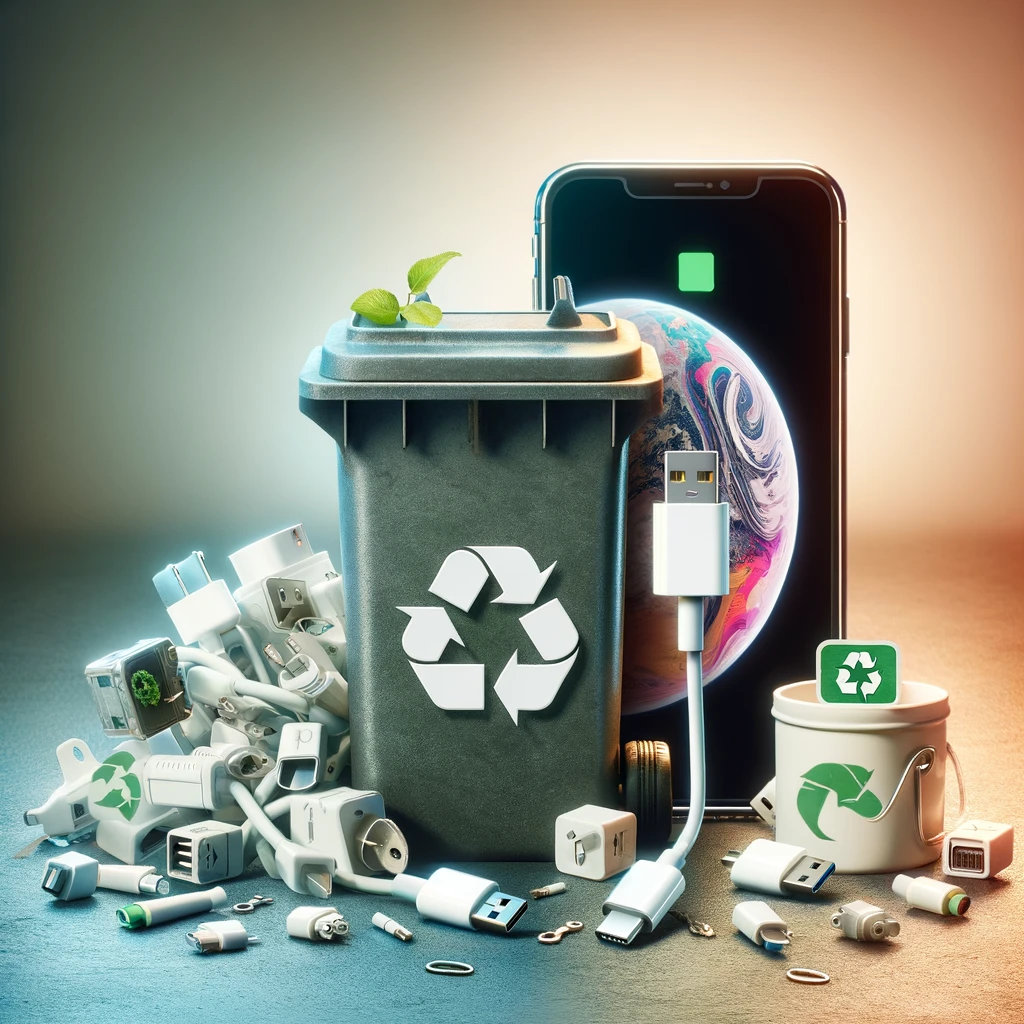
  • The Environmental Upside of the iPhone’s Shift to USB-C charger

    The Environmental Upside of the iPhone’s Shift to USB-C charger

    In a move that resonates with environmental and practical implications, a landmark decision by Apple to transition its iPhones to USB-C ports is making waves. This shift, beyond aligning with European Union regulations, actually shows how a seemingly small decision can have a huge impact.

    A Universal Charging Solution: Beyond User Convenience

    Apple’s decision to switch its iPhone lineup to USB-C ports represents a pivotal moment in sustainable tech, as it shows that even the biggest business listened to the EU and represents some hope with a “small change” that can have such a big impact. This transition offers the practical benefit of unifying charging solutions across a range of devices, but more importantly, it heralds a substantial reduction in electronic waste. With this change, the need for different cables for different devices is significantly reduced, minimizing the number of accessories produced and eventually discarded.

    The switch to USB-C in iPhones is not just a response to regulatory changes; it’s a step towards a sustainable technological future. This move aligns with the growing need for a circular economy in the tech world, where products are designed for longer lifespans, reusability, and efficient recycling.

    Why was the decision taken to move to USB-C chargers and why Apply did resist that change initially?

    To start, it is important to note that USB-C chargers offer several technical advantages over Apple’s Lightning chargers for iPhones:

    • Widespread compatibility: thus reducing the need for different cables and generating less waste.
    • Faster Data Transfer: USB-C enables quicker data synchronization with higher transfer rates, beneficial for managing large files efficiently.
    • Higher Power Delivery: It supports more powerful charging capabilities, allowing faster charging of devices, including power-intensive smartphones.

    Despite these benefits, Apple was initially reluctant to adopt USB-C for iPhones for a few reasons:

    • Proprietary Control: The Lightning connector allows Apple to maintain control over its product ecosystem, ensuring accessory compatibility and quality.
    • Revenue Stream: Through the Made for iPhone program, Apple gains revenue from third-party manufacturers using the Lightning connector.
    • Brand Differentiation: Keeping the Lightning connector helps differentiate Apple’s products in a market dominated by USB-C and micro-USB devices.

    As we know, iPhone did lose this fight and since iPhone 15, the phone comes with USB-C charging instead of the lightning cable. So let’s dwelve on the impact this can have.

    Quantifying the Environmental Impact

    Estimating the precise carbon reduction and avoided waste material from Apple’s switch to USB-C chargers for iPhones involves several assumptions and calculations based on available data. Here’s a simplified approach to estimate these impacts:

    1. Estimating the Global Active iPhone User Base:
      • As of 2021, estimates suggest there are over 1 billion active iPhone users worldwide.
    2. Replacement Cable Purchase Rate:
      • Assume a conservative estimate that 20% of these users purchase a replacement charger each year. This means 200 million replacement chargers annually (20% of 1 billion).
    3. Chargers Included with New iPhone Sales:
      • Apple reported selling approximately 217 million iPhones in 2020. If we assume that around 50% of these new iPhones are sold with chargers (considering Apple’s policy of not including chargers with every new phone), this results in an additional 108.5 million chargers (50% of 217 million).
    4. Total Chargers Annually (Replacement + New Sales with Chargers):
      • Total chargers annually = Replacement chargers + New sales with chargers = 200 million + 108.5 million = 308.5 million chargers.
    5. Carbon Footprint of Charger Production:
      • Using the assumed carbon footprint of 1.5 kg CO2e per charger, the total carbon footprint = 308.5 million x 1.5 kg CO2e = 462.75 million kg CO2e annually.
    6. Reduction in Production with USB-C Adoption:
      • Assuming a 30% reduction in charger production due to USB-C adoption, the reduction = 308.5 million x 30% = 93 million chargers not produced.
      • Corresponding CO2 reduction = 92.55 million x 1.5 kg CO2e = 138,825 tons of CO2e saved annually (the equivalent of 40,000 cars driving annually)
    7. Material Waste Reduction:
      • Average charger weight: 75 grams.
      • Material waste avoided = 92.55 million x 75 grams = 6,941.25 million grams or approximately 6,941 tonnes of avoided electronic waste per year.

    Conclusion

    Apple’s decision to adopt USB-C for its iPhones could set a new sustainability standard in the tech industry. While the exact environmental benefits in terms of material savings and CO2 emission reductions require precise calculations, the potential impact is clear and far-reaching. Yet, let’s not celebrate this too much, as eventually charging cables are only a tiny piece of Apple’s carbon footprint and real sustainable value will be delivered by producing longer-lasting phones, that can be more easily repaired and recycled. With 65kg of CO2e per iPhone (down 30% against baseline), making an iPhone’s life going from 3 to 4 years means a 20kg CO2e saved per iPhone, so much more than that 1,5kg that a charger represents; maybe this is the real question here ?


  • How procurement impacts the world and will make it a better place

    How procurement impacts the world and will make it a better place

    Recently, Schneider Electric announced it would help its largest 1,000 suppliers reduce their CO2 emissions. Schneider Electric Partners with Top 1,000 Suppliers

    I found this particularly interesting because, for the first time, I was reading about a company going beyond the usual framework of “understand your suppliers, tell them what you expect from them, and relax.” This approach was saying, “we will help you get there,” embracing the fact that suppliers and procurement could work together to achieve significant results where everyone benefits: Schneider Electric, the suppliers, and the suppliers’ customers.

    Sure enough, just getting visibility on one’s supply chain is difficult, tedious, and sometimes costly, but organizations are now understanding that this can be an opportunity to build customer loyalty and make an impact on the world.

    Procurement has realized this and has increasingly become the guarantor of Corporate Social Responsibility (CSR) policies within organizations, ensuring their supply chain aligns with the company values and objectives. The range of topics procurement has started to look at includes energy, health and safety, child labor, slavery, embargoed countries, certificates of origin for diamonds or rare earth, etc. When all procurement teams have raised their standards on these topics, the world will be a different place.

    Why is procurement uniquely positioned to fulfill this mission?

    • Procurement selects the suppliers and ensures they abide by the company’s standards of supply chain and sustainability. If there is no demand for products that do not meet a certain threshold, the suppliers will have no choice but to go out of business or comply with these requirements. This process is exactly the same as for B2C.
    • Procurement can create a snowball effect by imposing new standards on their suppliers, who in turn will “greenify” their suppliers generating a vertuous circle.
    • Procurement teams are the company’s ears and eyes on the suppliers’ market. As such, they can gain visibility on the latest sustainable innovations within the industry and bring them to their business.

    Faurecia’s VP of procurement, Nathalie Saint Martin, understands this unique position and makes procurement a key pillar for their CO2 emission reduction strategy:

    “Procurement is essential […] they represent 60% of our total emissions.” She adds that with “their new procurement policies, over 90% of the parts used are sourced within the region they are produced,” reducing their carbon footprint immensely.

    What mechanisms can be used to achieve this objective?

    CSR and sustainability is a long journey for organizations, which requires having a real discussion with the various business owners to define the objectives and allocate resources to achieve them. In a nutshell, the framework used is the following:

    • Define the principles and Supplier Code of Conduct: Done with the business owners, this involves listing the most important topics that matter to the company, documenting them, and sharing them with suppliers. These documents are the backbone of what the organizations stand for and should be signed by any supplier you do business with. They should remain fairly generic, with supplier or category-specific topics addressed separately, in more detail.
    • Define the right selection criteria for your purchases: Procurement can set two types of criteria when it tenders: the qualifying and differentiating ones.
      • The qualifying criteria will be the list of things you expect any supplier to meet to even be able to quote: Anti-slavery statement, no fiscal debt, etc. Usually, you would ask for these in the Request for Information.
      • The differentiating ones will be the criteria that are going to be weighted in the award decision: Can the supplier recycle their products? Do they use green energy, etc.? The important point here is to give some weight to these criteria in the decision process.
    • Audits: Know your suppliers. Combining on-site visits and technological surveillance (think AI scanning the internet for news mentioning your suppliers, or blockchain to track shipments), procurement now has efficient levers to audit their suppliers and ensure their supply base is complying with the required standards. The most famous example at the moment is EcoVadis, which helps you get an assessment of your suppliers and provides ongoing surveillance to avoid being caught off guard.
    • Supplier Relationship Management (SRM): SRM is a powerful tool for procurement to create more value by accompanying suppliers to meet the required standards, like Schneider Electric, or by working jointly with already best-in-class suppliers to co-create new products or services (like the 100,000 custom-made electric van deal between Amazon and Rivian).

    There is, of course, a multitude of different solutions to help organizations simplify and digitalize this process, but regardless of how, when all companies have established these processes successfully, the world will indeed be a better place. Stay tuned for more information on the solutions that I’ll share regularly