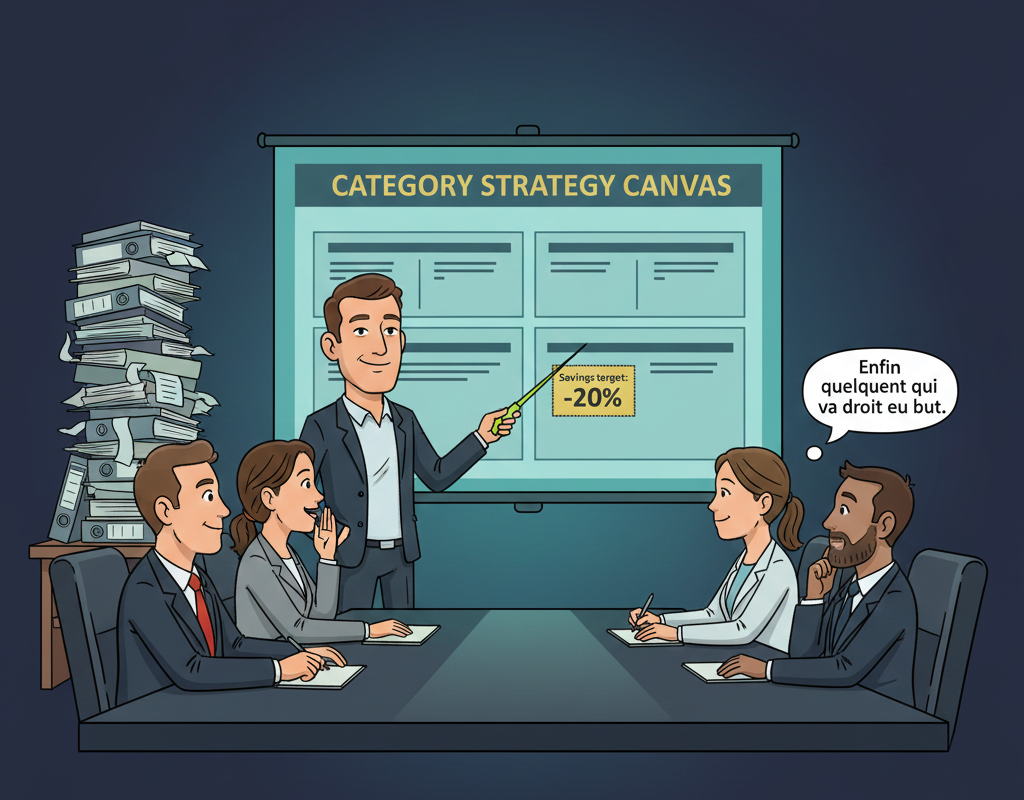
Category Strategy Canvas : Transform 5 weeks of analysis into 1 page that convinces your CEO
You have the 5 analyses. You have the data. You have the answers. But how do you convince your leadership in 3 minutes instead of 3 hours?
You’ve spent 5 weeks analyzing your category. Complete Spend Analysis. Detailed Porter analysis. Filled Kraljic Matrix. Cross-referenced supplier segmentation. Built cost breakdown. You have 15 Excel files, 300 PowerPoint slides, 2,000 lines of analysis.
Monday morning, you have a CEO meeting for 45 minutes. You have 5 minutes to explain your strategy before the executive wonders if he actually approved you for this project.
This is the moment you discover that the quality of your strategy isn’t measured by the depth of your analysis. It’s measured by your ability to synthesize it into 1 page your CEO can read in 3 minutes and approve on the spot.— Reality of category management
The Category Strategy Canvas is that synthesis tool. It’s a single A4 page (or 2 max) that contains all the decision-making elements: situation, objectives, initiatives, risks, KPIs. Nothing more. Nothing less. It’s your category strategy condensed into a format that kills it — the real Business Model Canvas of procurement.
The 8 sections of the canvas
A well-structured canvas has 8 sections that correspond to the complete decision-making logic of a category strategy. Each answers a specific question. Together, they tell the story of your category from present to future.
Section A — Category & Scope
The question: What exactly are we talking about?
This is the foundation. Without clear scope, everything else is fuzzy. You clarify: category name, scope (included/excluded), sub-categories, annual spend, number of suppliers, affected BUs, geographies. Format: 3-4 lines max.
Section B — Current Situation (AS-IS)
The question: Where are we today?
Spend breakdown (top 5 suppliers + %), Kraljic positioning (where it sits), current pain points (what’s not working), maturity level 1–5. This is your “before”. This is what justifies why you need to change.
Section C — Market Analysis (Synthesized Porter)
The question: What is our negotiating position?
Overall score (e.g., 18/25), negotiating position (Strong/Medium/Weak), 3–5 key market trends. This is what justifies your strategic approach (aggressive vs collaborative).
Section D — Strategic Objectives (3–5 max)
The question: What are we trying to accomplish over 2–3 years?
SMART objectives, categorized (Financial, Risk, Innovation, Sustainability, Operational). This is your “after”. This is what drives all objectives below.
- TCO -20% over 3 years
($8.5M → $6.8M) · Financial - Standardization
250 → 12 approved models · Operational - 50% refurbished devices by 2027 · Sustainability
- Dual sourcing on 100% of category · Risk
Section E — Key Initiatives (Roadmap)
The question: How do we get there? What is our action plan?
Table: Initiative | Timeline | Impact | Owner | Priority (MoSCoW). This is your execution roadmap over 12–24 months. Must be realistic and assigned.
Section F — Sourcing Strategy
The question: What supply model do we choose?
Approach (Competitive/Collaborative/Hybrid), geography (Local/Regional/Global), target number of suppliers, contract duration, priority value levers.
Section G — KPIs & Tracking
The question: How do we measure success?
Table: KPI | Baseline | Target | Frequency | Owner. This is how you’ll steer execution and justify results.
Section H — Risks & Mitigation
The question: What can stop us? How do we protect ourselves?
Table: Risk | Probability | Impact | Mitigation | Owner. Strategy without risks is naive. This section shows you’ve thought through plan B.
The complete canvas: IT Hardware example
Here’s what it looks like when filled in. This is the IT Hardware example you’ve seen build since article 1 of the series.
Laptops, Desktops, Tablets, Peripherals (monitors, keyboards, mice)
Excluding: Mobiles (Telecom), Servers (IT Infra)
Spend: $8.5M/year
Suppliers: 12 active
Geographies: 15 countries
BUs: 8
Dell 40%, HP 25%, Lenovo 15%, Apple 10%, Others 10%
Kraljic Quadrant: Leverage Effect
Pain Points: 250 different models, fragmented support, 40% off-contract
Maturity: 2/5
Key trends:
✓ Transition PC → Thin Clients
✓ Circular Economy (refurbishment)
✓ Potential chip shortage 2026
✓ AI in hardware
✓ OEM consolidation
($8.5M → $6.8M) · Financial
2. Standardization
250 → 12 models · Operational
3. Refurbished devices
50% by 2027 · Sustainability
4. Dual sourcing
100% coverage · Risk
Impact -$350k · MUST
Q2 2025: Catalog standardization
Operational impact · MUST
Q3 2025: Refurb pilot 100 devices
ESG impact · SHOULD
2026: Device-as-a-Service pilot
Innovation impact · COULD
(Competitive commodity, Collaborative innovation)
Geography: Global
Target suppliers: 3–4 (vs 12)
Contract duration: 3 years + 2 auto-renew
Levers: Price, TCO, Innovation
$0 → $1.7M (2027) · Monthly
Supplier Score:
60/100 → 85/100 · Quarterly
Contract Coverage:
60% → 95% · Monthly
Device Refurb %
0% → 50% · Quarterly
Mitigation: Pilot + change communication
Hardware supply chain: Prob 40%, Impact Critical
Mitigation: Dual sourcing, safety stock
Logistics increase: Prob 70%, Impact Medium
Mitigation: Indexed contracts, pooling
How to build the canvas: the complete process
The canvas doesn’t build itself and shouldn’t be built alone. Here’s the process that works.
Prepare inputs (2–3 days)
Strategy workshop (1–2 days)
Canvas writing (2–3 days)
Stakeholder validation (1 week)
Executive presentation (1h format)
Execution & tracking (ongoing)
How to present the canvas to your leadership
The 3 golden rules to get your strategy approved in 20 minutes.
Rule 1: Canvas first, details after
Classic mistake: Start with the 5 analyses, then get to the canvas at slide 30. By then, the executive is lost.
Correct approach: Slide 1 = the complete canvas. “Here’s our strategy in 1 page. Let’s dive into details if you want.” 90% of the time, the executive says “ok, execute”. 10% of the time, he asks for clarification, and you have your backup slides.
Rule 2: Financial impact first
CEOs think in financials. Objective #1 of the canvas should be a clear savings/financial impact. “TCO -20% in 3 years” makes it immediately clear. “Optimization of sourcing process” raises questions.
Put your gains front and center. The initiatives supporting them come second. Risks come third (not at the beginning, or you seem naive).
Rule 3: Anticipate the 3 inevitable questions
Your CEO will ask these 3 questions. If you haven’t anticipated them, you lose credibility.
Answer: “Based on [reliable source]. Validated by [stakeholder]. The baseline is conservative, the target is ambitious but realistic.”
Q2: “How long/how many resources does this take?”
Answer: “[X FTE/project]. Roadmap over 24 months. If I’m short on resources, here’s what we push back.”
Q3: “What do you need from me?”
Answer: “[Strategy approval] [Conflict arbitration] [BU support for change].” Be specific.
Classic mistakes to avoid
Canvas too detailed
Static canvas
Canvas built solo
Non-SMART objectives
Forgetting the Risks section
Canvas too ambitious on timing
The complete loop: how the 6 tools feed each other
You’ve reached article 6. You’ve seen 6 different tools across 6 articles. Why together? How do they connect?
#2 Porter’s Five Forces → You assess your negotiating position
#3 Kraljic Matrix → You prioritize where to act aggressively vs collaboratively
#4 Supplier Segmentation → You determine which suppliers to deepen relationships with
#5 Cost Breakdown / Should-Cost → You build your factual arguments
#6 Category Strategy Canvas ← You are here → You synthesize everything into a 2–3 year plan
And after: Every quarter, you revisit the canvas, update KPIs, adjust if reality changes. The canvas becomes your steering dashboard.
Why it matters: A canvas without the 5 underlying analyses is an empty document. The 5 analyses without the canvas are unexecuted intellectual exercises. The canvas IS proof that you’ve mastered the 5 tools.
And more importantly: a well-filled canvas validates that your strategy is solid. If you end up with a canvas that limps or lacks internal logic, it means one of your analyses isn’t good. The canvas forces rigor.
The best category strategy isn’t the one with the best analysis. It’s the one with the best execution. And the best execution starts with clarity of plan. The Category Strategy Canvas creates that clarity.— Synthesis principle
Where to start? (Immediate action)
The series is complete. You have 6 tools. But what do you start with Monday morning?
Option A: You have 1–2 weeks (limited time)
Start with a micro-category: not $100M spend, not 40 suppliers. Something with $2–5M spend and 4–6 suppliers. Takes you 4–6 weeks total, you deliver quickly, and you show concrete results. Then you scale to others.
Option B: You have 6–8 weeks (comfortable time)
Start on your strategic category #1. The one representing the biggest spend or biggest political issue. Do all 6 analyses, build the canvas, and present it to leadership. You position yourself as a transformation leader in procurement.
Option C: You work on multiple categories (scalability)
Start by standardizing your approach on one category. Then reproduce the process on the others. Once you master the 6 tools, you can handle 3–4 categories per year.
In summary: from theory to action
You have a complete set of category management tools:
- Spend Analysis: Real vs fake spend, categorized
- Porter’s Five Forces: Market position, negotiating leverage
- Kraljic Matrix: Strategic prioritization by category
- Supplier Segmentation: Supplier portfolio management
- Cost Breakdown / Should-Cost: Factual negotiation arguments
- Category Strategy Canvas: Synthesis and execution 2–3 years
Together, they form a coherent system. None is worth much in isolation. All together, they create a category strategy that holds up in front of leadership, can be defended against suppliers, and generates measurable results.
The canvas is your finish line. But it’s also the beginning of execution. You have an approved strategy. Now you deliver it. Quarter by quarter. KPI by KPI. Initiative by initiative.
The difference between a buyer and a category manager isn’t the title. It’s the ability to think strategically, to synthesize complexity into clarity, and to execute a plan over 2–3 years. The Category Strategy Canvas is the document that materializes this difference.— Practical definition of category management
The series is complete. Your work begins.
- Article #0 — Introduction · Roadmap
- Article #1 — Spend Analysis : Where does the money go?
- Article #2 — Porter’s Five Forces : What is your market position?
- Article #3 — Kraljic Matrix : Where should you prioritize your effort?
- Article #4 — Supplier Segmentation : How do you manage your portfolio?
- Article #5 — Cost Breakdown & Should-Cost : How to negotiate with facts?
- Article #6 — Category Strategy Canvas : What is your action plan? ← You are here