
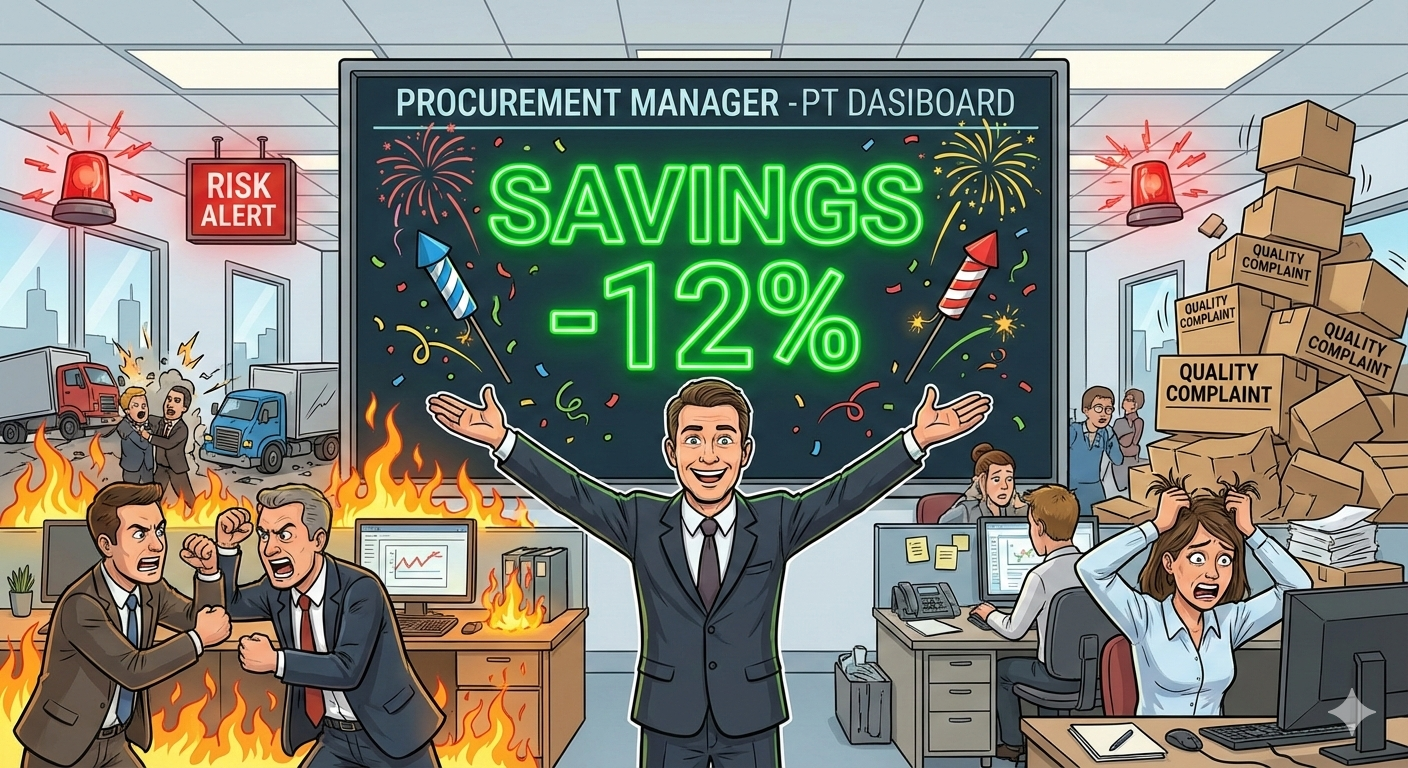
“How much did you save this year?”
In many companies, when procurement performance is measured, it’s often based on a single criterion: savings.
And while savings are important, focusing solely on them is like driving a car by only looking at the speedometer.
You’re going fast… but where to? And at what cost?
In this article, I’ll show you why procurement performance goes far beyond the savings figure, how to measure the overall value you create, and most importantly, how to escape the trap of cost reduction at all costs.
Savings vs Cost Avoidance: Understanding the Difference
Savings
Definition: Tangible and measurable reduction of an existing expense.
Example: You renegotiate a maintenance contract. The price drops from €100k to €90k.
Saving: €10k (visible on the P&L)
Characteristics:
- Immediate impact on the income statement
- Easily measurable
- Indisputable (before/after invoices)
- Valuable in direct ROI
This is what matters most… in the immediate term.
Cost Avoidance
Definition: Prevention of a future cost increase.
Example: Your supplier announces an 8% increase for next year. You negotiate an indexation capped at 3%.
Cost avoidance: 5% avoided (but no visible decrease on current invoices)
Characteristics:
- No direct P&L impact
- More difficult to measure
- Requires a counterfactual scenario (“what would have happened if…”)
- Often contested by finance
The problem? Cost avoidance is often ignored or minimized, even though it represents real value.
Why Both Matter
A buyer who only generates cost avoidance risks not being recognized.
A buyer who only generates savings risks weakening the company in the long term.
True performance? It’s about balance.
Procurement ROI: The Metric That Matters… But Not the Only One
How to Calculate Procurement ROI
Formula:
ROI = ((Savings – Procurement Function Costs) / Procurement Function Costs) × 100%
Example:
- Savings generated: €5M
- Procurement function costs (salaries, tools, travel): €1M
- ROI: (€5M – €1M) / €1M = 400%
Benchmarks:
- Excellent ROI: 300-500%
- Good ROI: 200-300%
- Average ROI: 100-200%
- Low ROI: <100%
Translation: For every €1 invested in procurement, you generate €4 of value.
It’s a powerful argument to justify the existence and development of the procurement function.
Why ROI Alone Isn’t Enough
As mentioned earlier, focusing solely on savings cannot suffice and can even lead to deviant, counterproductive behaviors.
Scenario 1: Toxic ROI
You generate €10M in savings with a 500% ROI.
But:
- Your defect rate has doubled
- 3 strategic suppliers are in financial difficulty
- You’ve lost 2 months on a key product launch
The ROI says: success. Reality says: disaster.
Scenario 2: Invisible Value
You deploy an e-procurement platform that reduces lead times by 40%.
You secure 3 sources of supply for a critical component.
You integrate sustainability into 80% of your contracts.
The ROI says: €0 (no direct savings). Reality says: strategic transformation.
Conclusion: Procurement ROI is necessary, serving as the basis for measuring procurement performance. While this indicator is key at the beginning, it becomes less important as the team matures. Maintaining a positive ROI remains key in many situations, although strict risk management in certain industries means a low ROI for procurement and that’s OK — as long as overall performance is evaluated.
The Trap of Savings at All Costs
How You Fall Into the Trap
It often starts innocently:
- Year 1: “Procurement must generate 2% savings on spend.”
- Year 2: “You did 2%? Perfect. This year, we want 3%.”
- Year 3: “3% again.”
- Year 5: “We still want 3%… but we’ve already negotiated everything.”
Result: To maintain savings, you start to:
- Over-challenge suppliers (who break or deliver poorly)
- Downgrade specs (at the expense of quality)
- Delay investments (innovation, tools, processes)
It’s the negative spiral.
Collateral Damage
1. Quality Erosion
Real case: An automotive manufacturer demands 5% annual reduction on parts.
Result:
- Suppliers reduce quality controls
- Defect rate goes from 0.5% to 2%
- Cost of recalls: €50M
Procurement savings: €10M. Total cost: -€40M.
2. Supplier Fragility
Real case: A tech company pressures its suppliers on margins.
Result:
- 2 suppliers go bankrupt
- 3-month supply disruption
- Cost of launch delay: €100M in lost revenue
Procurement savings: €5M. Total cost: -€95M.
3. Loss of Innovation
Real case: A retailer refuses any price increase, even justified ones.
Result:
- Suppliers stop investing in R&D
- No new differentiating products
- Loss of market share: -15% in 2 years
Procurement savings: €3M. Strategic cost: priceless.
The Symptom: When Procurement Becomes a Cost Center
If your management only sees procurement as a cost reduction item, you’re in the trap.
Procurement becomes a cost center instead of a value center.
And that’s when everything breaks down.
Keys to a Balanced Approach
To avoid the trap and measure true procurement performance, three fundamental pillars are necessary:
01. Clear Indicators & Validated Methodology
Why it’s essential:
Precise definitions are the foundation of everything. You can’t manage what you can’t measure.
What this implies:
- Shared definitions: What is a “saving”? A “cost avoidance”? How do you calculate ROI?
- Documented calculation rules: What baseline? What comparison period? What costs included?
- Clear scope: Which purchases are in scope? Which are excluded and why?
- Validated methodology: Finance, operations, and management must approve the method before applying it
Concrete example:
You negotiate a 3-year contract with a 5% reduction in year one, then 2% indexation in subsequent years.
Without clear definition:
- Procurement counts 5% savings every year (on initial base)
- Finance contests and only counts the first year
- Conflict, lost credibility
With clear and validated definition:
- Year 1: 5% savings (vs baseline)
- Year 2: 3% savings (5% initial – 2% indexation) or cost avoidance depending on agreed definition
- Year 3: same
- Everyone agrees from the start
02. Transparent Reporting
Why it’s essential:
Transparency builds credibility. Regular validation sessions between finance and procurement are scheduled.
What this implies:
- Monthly or quarterly reviews: Savings are presented and challenged
- Systematic documentation: Each saving has a “business case” with source, calculation, validation
- Complete traceability: Before/after invoices, contracts, approvals
- Financial alignment: Procurement savings are reflected in the P&L or explained (timing, scope)
Concrete example:
Bad practice:
- Procurement announces €2M in savings at year-end
- Finance asks for proof
- Several weeks to find elements
- 40% of savings are contested
- Credibility = 0
Good practice:
- Shared Procurement-Finance dashboard updated monthly
- Each saving documented at the time of realization
- Quarterly validation session of 2 hours
- -Adjustments made in real-time
- No surprises at year-end
- Maximum credibility
03. Balanced Objectives Aligned with Strategy
Why it’s essential:
Procurement KPIs must reflect the function’s overall contribution and be aligned with company priorities.
What this implies:
- Mix of indicators: Not only financial, but also operational, strategic, and resilience
- Weighting according to maturity: An immature procurement function focuses on savings. A mature function balances all pillars
- Strategic alignment: If the company prioritizes innovation, procurement is measured on its contribution to innovation
- Adaptability: Objectives evolve with context (crisis = resilience, growth = innovation, difficulties = cash)
Concrete example:
Unbalanced approach:
- Single objective: 3% savings on spend
- Result: Savings achieved, but quality degraded, innovation stopped, suppliers weakened
- Negative overall impact
Balanced approach:
- 2025 Procurement Objectives:
- Financial (40%): 2% validated savings + ROI >300%
- Operational (25%): P2P cycle <5 days + On-time delivery >95%
- Strategic (20%): 70% of spend with ESG criteria + 3 supplier innovations integrated
- Resilience (15%): No critical disruptions + Dual sourcing on key components
Result:
- Balanced performance
- Contribution to overall strategy
- Recognition of total value
- Transformation from cost center to value center
—
In Summary: Transforming Procurement from a Cost Center to a Value Center
Savings matter. a lot.
But they are only part of the value that procurement creates.
True procurement performance rests on three pillars:
✅ Clear indicators and a validated methodology
You can’t manage what you can’t measure. Precise definitions, documented rules, validation by all stakeholders.
✅ Transparent and regular reporting
Credibility is built through transparency. Validation sessions with finance, systematic documentation, P&L alignment.
✅ Balanced objectives aligned with strategy
Not just savings, but a mix of financial, operational, strategic, and resilience indicators that reflect company priorities.
With these three pillars in place, you avoid the trap of savings at all costs.
You measure the true value you create.
You transform procurement from a cost center into a value center.
And that’s the true role of procurement.
—
And you, how do you measure your procurement performance? Have you implemented a balanced approach?
—
🙋🏻♂️ I’m Alex, a procurement expert passionate about structuring procurement practices and creating sustainable value.
♻️ Did this article bring you value? Share it with your network.
📲 Follow me for actionable insights on procurement levers and strategic sourcing.