The EU’s Next Step Towards Sustainable Supply Chains
As part of its broader goal to build a sustainable economy and fight climate change, the EU has taken an important step with the Corporate Sustainability Due Diligence Directive (CSDDD or CS3D). This legislation goes beyond encouraging voluntary practices by mandating that large companies across Europe and globally integrate human rights and environmental considerations into their supply chains. By doing so, the EU aims to make supply chains greener, more ethical, and more resilient in the face of climate change.
And with penalties that can reach up to 5% of the global revenue, this is not something to be ignored !
In this article, we will look at what the CSDDD is, what the obligations on business are going to be and how to navigate this with local law.
You can access the text from the EU here
1. What is the CSDDD?
The Corporate Sustainability Due Diligence Directive (CSDDD) is a legislative proposal introduced by the European Commission in February 2022. Its primary aim is to promote responsible business practices by requiring companies to identify, mitigate, and prevent human rights violations and environmental damage across their supply chains. The directive addresses the entire value chain, including suppliers and business partners both within and outside the EU.
In addition to this, the Directive introduces a climate change mitigation plan, mandating that companies align their business models with the Paris Agreement’s goal of limiting global warming to 1.5°C and achieving climate neutrality by 2050.
2. Who is Concerned?
The CSDDD targets large corporations operating in the EU and globally, divided into two main categories:
- Large EU Companies: Companies with more than 500 employees and a turnover exceeding €150 million.
- High-Risk Sectors: Companies in sectors such as textiles, agriculture, and mining with over 250 employeesand turnover exceeding €40 million.
- Non-EU Companies: Non-EU companies with significant business operations in the EU and meeting the same thresholds as EU companies.
These companies are expected to integrate sustainability due diligence into their operations and supply chains, ensuring compliance with the directive’s requirements.
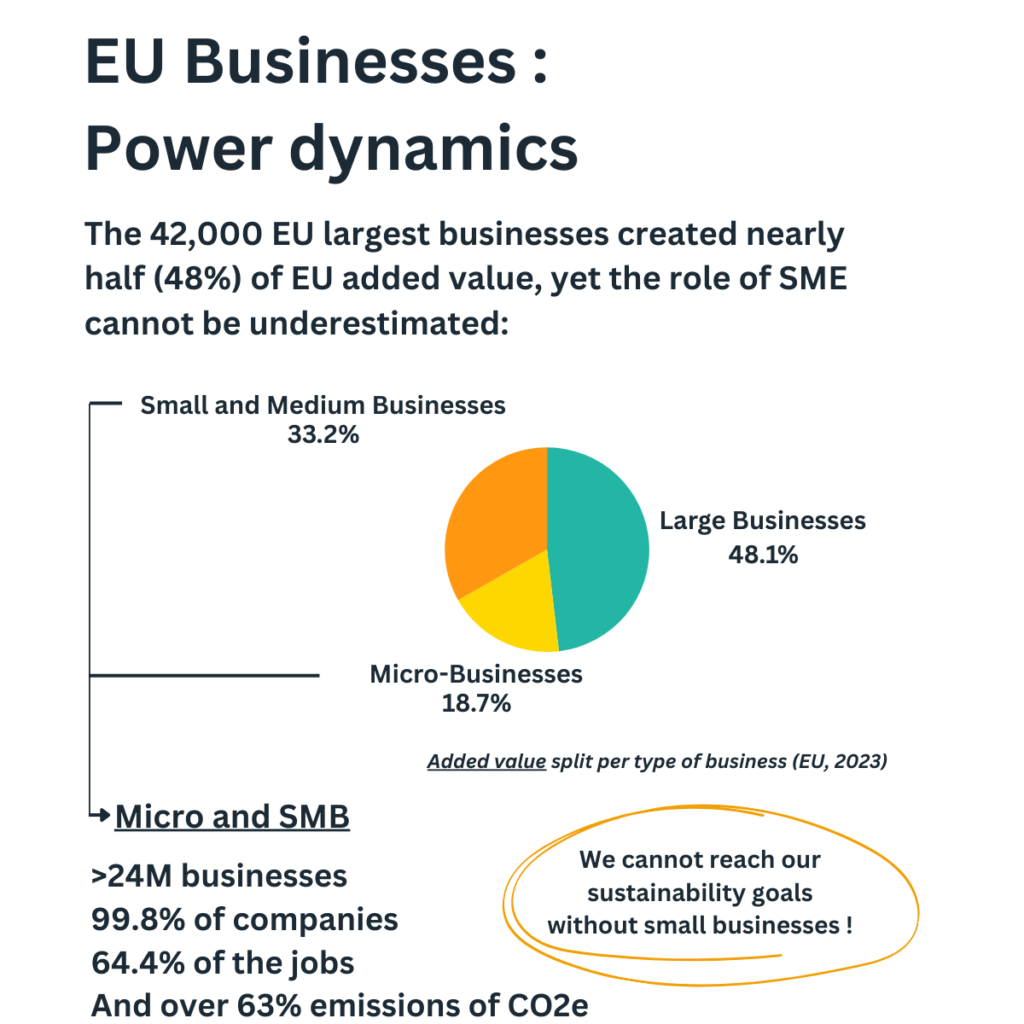
Despite covering around 6,000 EU companies and 900 non-EU companies, the directive indirectly affects a larger number of small and medium-sized enterprises (SMEs) through the supply chains of these large companies. This significantly extends the impact of the directive across the global economy.
For context, while the role of SME is key in EU, the 42000 largest businesses account for 52% of the added value and 37% of the carbon emissions. Tackling this, while having repercussions over the remaining businesses is likely to have massive impacts.
3. What is Expected from Businesses?
Companies under the scope of the CSDDD are required to adhere to due diligence duties that ensure sustainability is embedded throughout their operations. These key requirements include
- Integrate Due Diligence into Policies and Risk Management Systems (Article 5):
- Implement a policy to ensure risk-based human rights and environmental due diligence.
- Integrate due diligence policies and processes across the company and within risk management systems.
- Identify and Assess Actual or Potential Adverse Impacts, and Prioritize Based on Severity (Article 6):
- Map the company’s own operations and those of its upstream and downstream supply chain.
- Conduct periodic in-depth assessments using relevant internal and external information sources.
- Prioritize impacts based on severity and likelihood.
- Prevent and Mitigate Potential Adverse Impacts, and Bring Actual Impacts to an End or Minimize Their Extent (Articles 7 & 8):
- Take appropriate measures to prevent and mitigate impacts and bring actual impacts to an end or minimize their extent.
- Develop corrective action plans and seek contractual assurances from business partners.
- Engage in multi-stakeholder initiatives, providing support to SMEs where applicable.
- Conduct effective stakeholder engagement during the due diligence process.
- Establish and Maintain a Notification Mechanism and Complaints Procedure (Article 9):
- Set up a company-level notification mechanism accessible to affected stakeholders and representatives.
- Institute procedures to address complaints raised through the notification mechanism in a fair, transparent, and accessible manner.
- Provide adequate information on the notification mechanism to employees and stakeholders.
- Monitor the Effectiveness of Due Diligence Policies and Measures (Article 10):
- Carry out periodic assessments of the effectiveness of due diligence policies and the measures implemented to address potential and actual adverse impacts.
- Publicly Communicate on Due Diligence (Article 11):
- For companies subject to the Corporate Sustainability Reporting Directive (CSRD), report due diligence through CSRD-compliant disclosures.
- Other companies must issue an annual statement describing their due diligence efforts.
- Combatting Climate Change (Article 15):
- Adopt and implement a climate transition plan in line with the Paris Agreement, with time-bound targets supported by decarbonization levers and resourcing strategies.
4. Transition Plans for Climate Change Mitigation
A critical requirement of the CSDDD is the development of climate change mitigation transition plans that align with the Paris Agreement. Companies must:
- Set time-bound targets for 2030 and 2050 for reducing carbon emissions.
- Detail the decarbonization levers they will employ, including specific actions and investments.
- Provide an outline of the role of management in achieving these targets and quantify investments and funding dedicated to implementing the transition plan.
Companies already complying with the EU Corporate Sustainability Reporting Directive (CSRD) will be considered compliant with this requirement under the CSDDD.
5. How Does the CSDDD Interact with Other Laws?
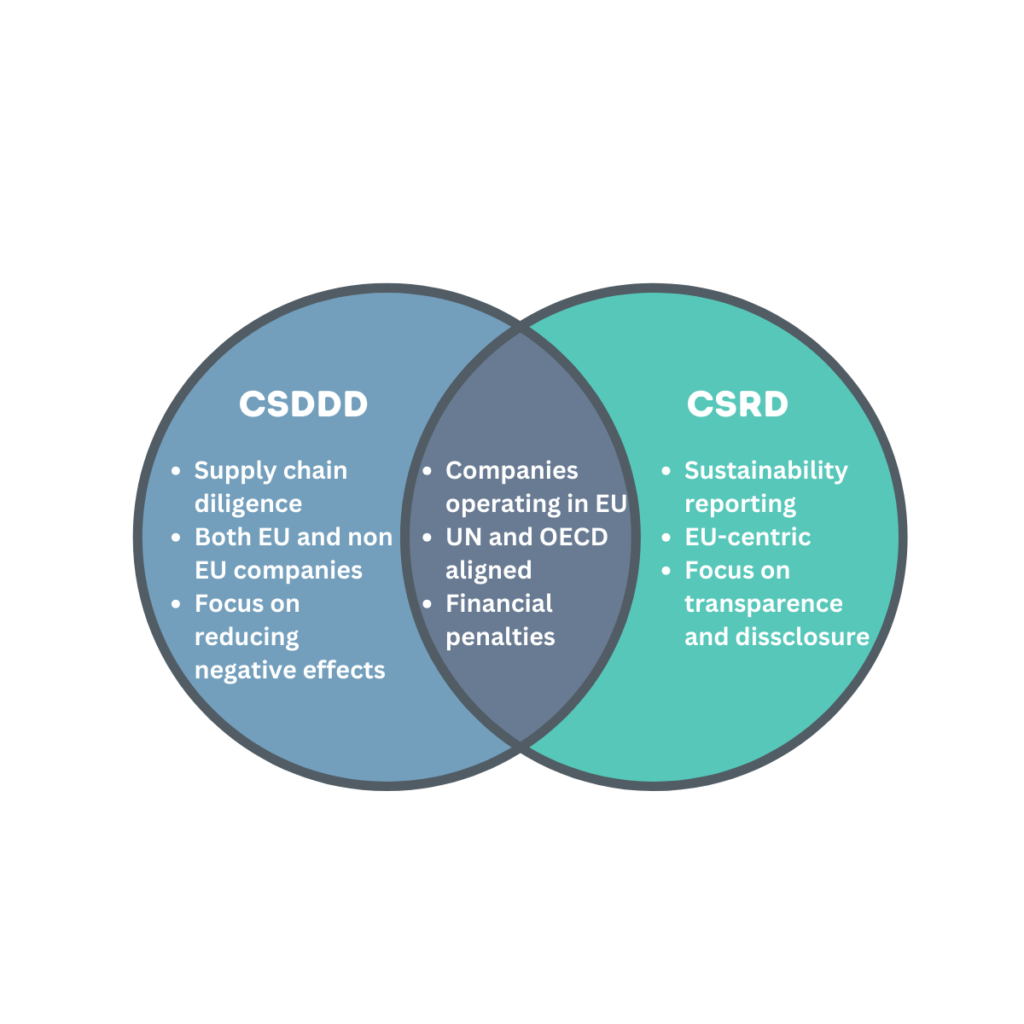
The CSDDD complements and interacts with several other EU and national laws, such as:
- Germany’s Supply Chain Act (LkSG), which has similar due diligence requirements.
- France’s “Loi de Vigilance”, which requires companies to implement vigilance plans to prevent human rights abuses and environmental damage in their global supply chains.
- Other EU laws include the Conflict Minerals Regulation, Batteries Regulation, and the forthcoming Forced Labor Regulation.
The CSDDD ensures minimum harmonization across the EU, meaning that Member States can impose stricter requirements but cannot lower the level of protection. Companies must meet the highest standard when different regulations overlap.
6. Why Does CSDDD Matter?
The directive introduces legal accountability for businesses. Non-compliance can result in significant penalties, and companies may face civil liability if they cause or fail to prevent human rights violations or environmental harm.
Beyond legal implications, adhering to the CSDDD also enhances brand reputation and investor confidence, as businesses can demonstrate their commitment to sustainability.
Additionally, the CSDDD aligns with global trends. Countries such as Canada and South Korea are considering similar legislation, and the UN is negotiating a binding instrument on business and human rights. Thus, the directive not only prepares EU companies for future international regulations but positions them to be leaders in sustainable business practices.
5. Why Was There a Need for the CSDDD?
Previous voluntary frameworks, such as the UN Guiding Principles on Business and Human Rights and the OECD Guidelines for Multinational Enterprises, were insufficient in ensuring that companies comprehensively integrate sustainability across their supply chains. Research revealed that companies often focused only on their first-tier suppliers, leaving significant risks further down the value chain unaddressed.
Moreover, inconsistencies in national laws created a fragmented legal landscape across the EU, which increased the administrative burden on companies and caused legal uncertainty. The CSDDD seeks to harmonize due diligenceacross the EU, making it easier for businesses to navigate the legal landscape and take meaningful actions to mitigate risks.
6. When Will the Rules Start Applying?
The CSDDD was published in the Official Journal of the European Union in July 2024, with full enforcement starting in 2027:
- 2027: Applies to EU companies with over 5,000 employees and €1.5 billion turnover, and non-EU companies with similar EU operations.
- 2028: Covers companies with 3,000 employees and €900 million turnover.
- 2029: All other companies falling within the scope of the directive will be subject to the requirements.
Companies that fail to comply with their obligations under the CSDDD are subject to:
- A fine of up to 5% of their global turnover;
- Compensation to victims for damages caused by non-compliance with due diligence obligations;
- Public disclosure of the names of companies penalized and the sanctions imposed.
7. How Does the CSDDD Affect SMEs?
While SMEs (small and medium enterprises) are not directly under the scope of the CSDDD, they may still be indirectly affected. Larger companies may require their smaller business partners to align with due diligence requirements as part of their supply chain obligations. To protect SMEs, the directive includes provisions to support these businesses, ensuring they receive the necessary financial and non-financial assistance from larger companies. The directive also mandates the reporting company to inquire at the most likely level of abuse, ensuring the due diligence requirements aren’t just massively sent out.
8. What Are the Key Human Rights and Environmental Impacts Covered?
The CSDDD is based on internationally recognized human rights standards, as outlined in conventions referenced by the UN Guiding Principles. The environmental aspects cover a range of impacts, including pollution prevention, biodiversity preservation, and climate change mitigation, all derived from multilateral environmental agreements.
Conclusion
The CSDDD represents a pivotal moment in the EU’s push towards a sustainable economy. By ensuring that companies are held accountable for the human rights and environmental impacts across their entire supply chains, the directive aims to create a fairer and greener global economy. Companies complying with the CSDDD will not only mitigate legal risks but also position themselves as leaders in the sustainability transition, enhancing their resilience and competitiveness in a rapidly evolving global marketplace.