EU Sustainability Objectives
On 2 May 2022, the 8th Environment Action Programme (EAP) entered into force, as the EU’s legally agreed common agenda for environment policy until 2030. This little publicized move is creating a number of noticeable changes throughout Europe and is perhaps marking the beginning of the revolution: less talking, more doing with more actions being felt at every level: businesses, governments, and individuals.
The long-term priority objective is that, by 2050 at the latest, Europeans live well, within planetary boundaries, in a well-being economy where nothing is wasted. Growth will be regenerative, climate neutrality will be a reality, and inequalities will be significantly reduced.
There are six priority objectives to 2030
- achieving the 2030 greenhouse gas emission reduction target and climate neutrality by 2050
- enhancing adaptive capacity, strengthening resilience, and reducing vulnerability to climate change
- advancing towards a regenerative growth model, decoupling economic growth from resource use and environmental degradation, and accelerating the transition to a circular economy
- pursuing a zero-pollution ambition, including for air, water, and soil and protecting the health and well-being of Europeans
- protecting, preserving, and restoring biodiversity, and enhancing natural capital
- reducing environmental and climate pressures related to production and consumption (particularly in the areas of energy, industry, buildings and infrastructure, mobility, tourism, international trade and the food system)
These objectives are ambitious as they are all-encompassing and if realized, will make Europe a truly great place to live in, but how do they translate into the daily life of hundreds of millions of Europeans?
How does that commitment translate to daily life?
Business side
Europe is already a constraining destination when it comes to doing business, or at least it is often said, because of all its regulations, and this is likely to get worse, but for the good cause. Businesses already have to comply with many obligations regarding the safety of the products (CEE for instance), and about child/forced labor, etc.. and have soon to comply with the Corporate Sustainability Reporting Directive (LINK article), but this is not the only change that impacts businesses.
Here are a few of the latest or upcoming changes, note that this is not a comprehensive list, just a few items that I thought significant because they go beyond the education framework and translate into real impacts:
- IPhone charging cable: Maybe the latest and most written about change, is when the EU forced Apple to get rid of their charging cable and sell iPhones that use the same USB-C cable as all other phones to limit electronic waste.
- Reparability index in France for instance, manufacturers are required to indicate the level of repairability of their products, this is the latest in a move that is designed to give consumers more transparency onto what consumers are buying and eventually drive changes. France is now taking this even further, with the creation of a subsidy for people to repair electronic goods instead of throwing them away. This is a great move as this creates both a new habit for consummers, and an industry for repairing electronics.
- Corporate Sustainability Due Diligence Directive: the next level of CSRD. When CSRD only sets up the framework for reporting the sustainability impact of a company, this directive would oblige these companies to develop a plan that’s in line with the objective of carbon neutrality and Paris Climate Change.
- Ban of single-use plastic items: From 3 July 2021, single-use plastic plates, cutlery, straws, balloon sticks and cotton buds cannot be placed on the markets of the EU Member States
Overall, the general increased sensibility to sustainable topics in Europe is a big driver for corporate behavioral change, as consumers are now considering these criteria more and more in their buying decisions.
Government side
Governments have long been talking about sustainability and how to implement measures to fight climate change. Over the years, many cities have taken initiatives to make living in it more sustainable: promoting greener transportation, increasing energy efficiency and limiting public lighting, or the maybe more controversial meat reductions in school canteens. Now, Europe is going one step further by giving cities a more pregnant role with real, measurable objectives that they have to commit by.
I’ll take the example of France, which set up the Climate-Air-Energy Territorial Plans (Plans Climat-Air-Énergie Territoriaux, PCAET), which are individual to each city and lay out the different initiatives to take along with clearly defined KPI. This approach is bounded to be replicated across EU (and cities like Copenhagen haven’t waited !)
France’s PCAET: The Climate-Air-Energy Territorial Plans in France exemplify this shift. Mandatory for inter-municipalities with over 20,000 inhabitants, PCAETs encompass a range of sustainability metrics that they will have to hit :
Here is a table outlining various sustainability topics along with two examples for each:
| Sustainability Topic | KPI 1 | KPI 2 |
|---|---|---|
| Greenhouse Gas Emissions Reduction | Reduce emissions by 40% from baseline by 2030 | Achieve carbon neutrality by 2050 |
| Renewable Energy Adoption | Source 50% of the city’s energy from renewables | Install solar panels on public buildings |
| Energy Efficiency | Reduce energy consumption in buildings by 30% | Implement energy efficiency retrofits in homes |
| Sustainable Transportation | Increase public transportation usage | Add miles of protected bike lanes |
| Waste Reduction and Recycling | Achieve a 60% recycling rate | Implement city-wide composting programs |
| Water Conservation and Quality | Reduce potable water use | Improve water bodies to exceed environmental standards |
| Urban Greening and Biodiversity | Increase green space per capita | Plant a specific number of trees |
| Air Quality Improvement | Reduce levels of air pollutants like PM2.5 or NOx | Implement low-emission zones |
| Climate Resilience and Adaptation | Develop strategies against climate risks like flooding | Enhance resilience in vulnerable neighborhoods |
| Community Engagement and Education | Involve a percentage of the community in sustainability initiatives | Establish partnerships with local businesses for sustainability |
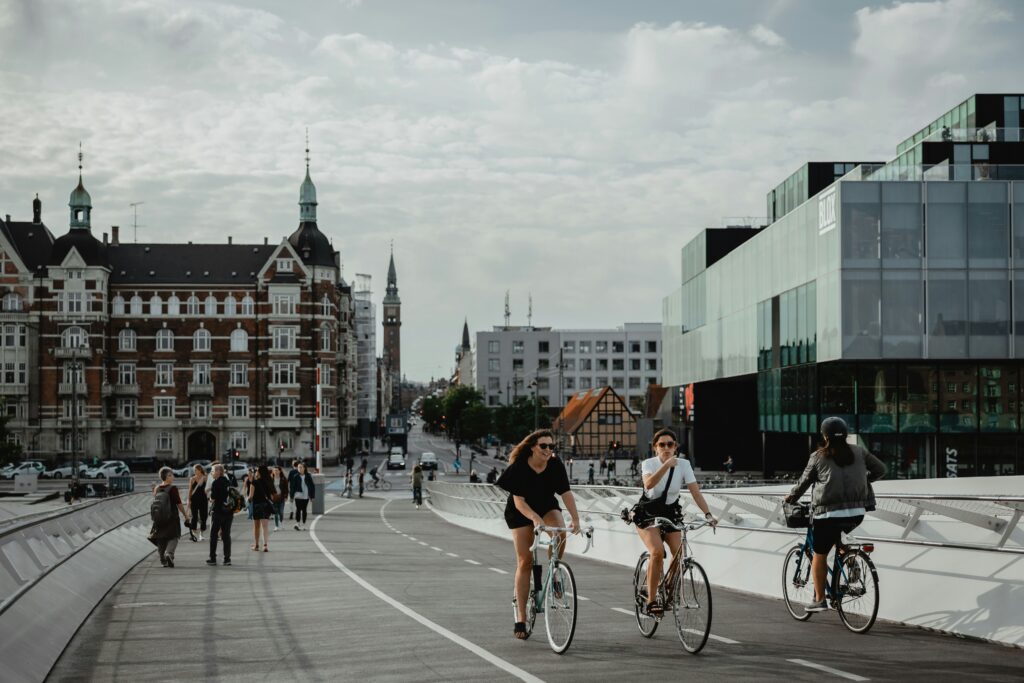
Copenhagen’s Climate Plan: Copenhagen, Denmark, is at the forefront of urban sustainability with its ambitious Climate Plan aimed at becoming the world’s first carbon-neutral capital by 2025. Key initiatives include:
- Extensive cycling infrastructure, promoting a bike-friendly city where more than 60% of residents cycle to work or school.
- Large-scale investment in renewable energy sources, particularly wind power, contributing significantly to the city’s energy mix.
- Innovative green building practices and energy-efficient housing developments.
- Implementation of integrated waste management systems focusing on recycling and reduction of landfill waste.
- Progressive urban planning incorporating extensive green spaces and water management systems to combat the effects of climate change and enhance the city’s resilience.
The European Union’s determined approach, as embodied in the 8th EAP and reflected in initiatives like France’s PCAET, marks a significant transition from dialogue to decisive action in environmental sustainability. These comprehensive strategies, spanning from business regulations to urban planning, demonstrate a commitment to reshaping Europe into a sustainable, resilient, and equitable society. This evolution from planning to implementation signifies a crucial step towards meeting the global challenges of climate change and environmental degradation, setting a commendable example for regions worldwide.
And you, what recent change do you think is the most important ?