

In the realm of business sustainability, two key objectives that stand out are achieving net-zero emissions and carbon neutrality. Both are integral to the broader goal of carbon equivalent reduction, which focuses on minimizing the carbon footprint of a business. Understanding these objectives and their distinct characteristics is crucial for businesses aiming to make impactful environmental contributions. Let’s delve into these concepts, highlighting their definitions, key performance indicators (KPIs), and the differences between them.
Net-Zero Emissions
Definition and Objective: Net-zero emissions refer to achieving a balance between the amount of greenhouse gases (GHGs) emitted into the atmosphere and the amount removed from it. The ultimate goal is to create a scenario where a company’s activities do not add to the atmospheric concentration of GHGs.
Key Performance Indicators (KPIs):
- GHG Emissions Reduction: Measured in metric tons of CO2 equivalent (CO2e), this KPI tracks the reduction in emissions due to changes in operations, energy use, and other factors.
- Renewable Energy Usage: The percentage of energy consumption that comes from renewable sources.
- Carbon Sequestration Efforts: Quantifies the amount of CO2e removed from the atmosphere through initiatives like reforestation or carbon capture technologies.
- Energy Efficiency Improvements: Measured in terms of reduced energy consumption relative to output, this reflects the efficiency of operations.
- Supply Chain Emissions: Emissions attributed to the supply chain, also measured in CO2e.
Carbon Neutrality
Definition and Objective: Carbon neutrality focuses on offsetting the amount of CO2 emissions produced by a business with an equivalent amount of CO2 reduction or removal elsewhere. Unlike net-zero, it does not necessarily require a reduction in emissions but rather balances them through various offset mechanisms.
Key Performance Indicators (KPIs):
- Total Carbon Emissions: The total amount of carbon emissions produced, measured in CO2e.
- Offset Projects: The scale and impact of projects invested in to offset emissions, such as renewable energy projects or reforestation.
- Carbon Credits Purchased: The number of carbon credits bought to offset emissions, usually measured in metric tons of CO2e.
- Emission Intensity: The ratio of emissions to company output, providing insight into how emissions relate to business activities.
Differences Between Net-Zero and Carbon Neutrality
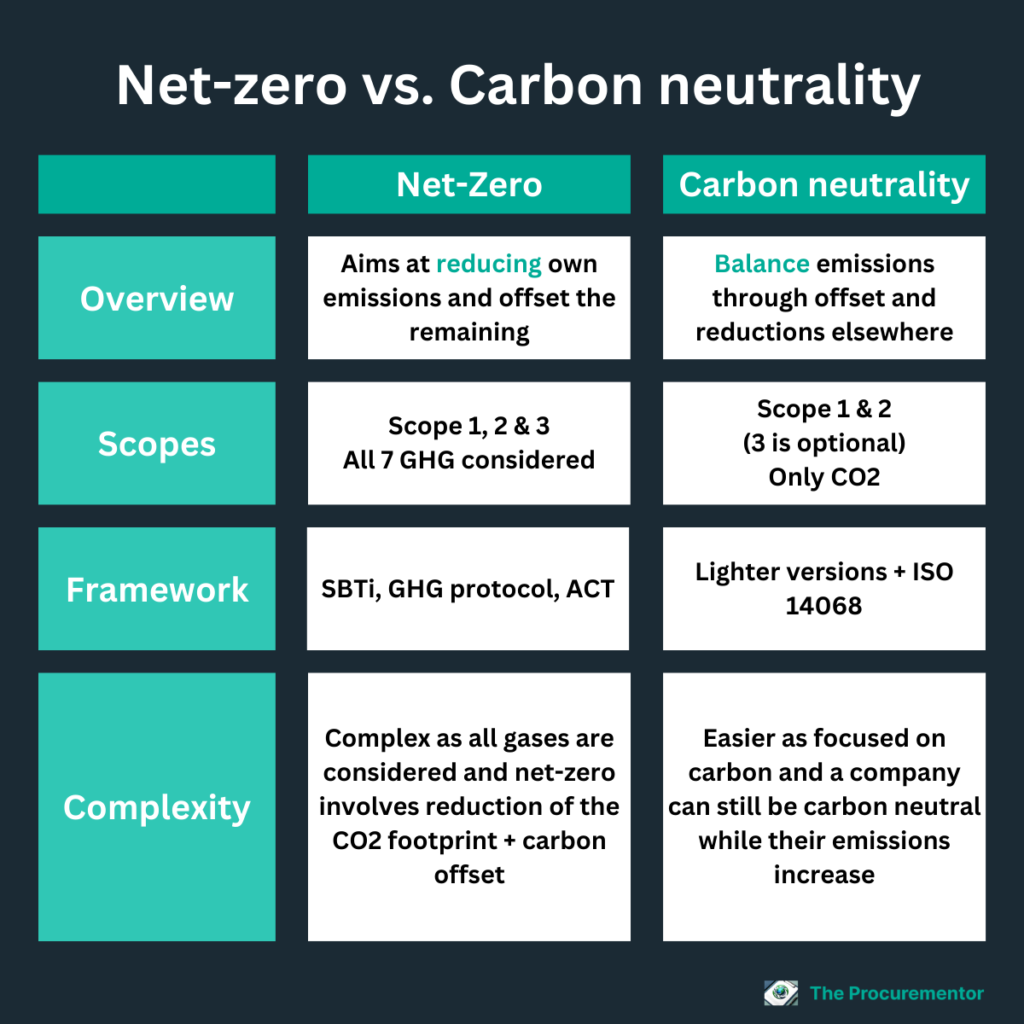
While both net-zero and carbon neutrality are centered on the idea of reducing the carbon footprint, they differ in approach and scope:
- Approach: Net-zero is about actively reducing the emissions a business generates, while carbon neutrality often involves counterbalancing emissions through offsets.
- Scope: Net-zero considers all greenhouse gases and requires a comprehensive strategy that may include changes in operations, energy sourcing, and product design. Carbon neutrality is often more focused on carbon dioxide emissions and can be achieved through offsetting measures without extensive operational changes.
- Long-term Impact: Achieving net-zero is typically seen as more sustainable in the long term, as it implies a fundamental shift towards lower emissions, whereas carbon neutrality can rely heavily on offsetting existing emissions.
In the journey towards a more sustainable future, understanding and choosing between net-zero emissions and carbon neutrality is crucial for businesses. While net-zero requires a deep transformation towards reducing GHG emissions, carbon neutrality offers a balance through offsetting. This decision reflects a company’s commitment to environmental stewardship and its role in fostering a sustainable, economically resilient future. Embracing these strategies is more than compliance; it’s a step towards positive change in our global ecological narrative.